Character Coding and State Space
How unobserved character states bias Bayesian morphological phylogenetics
For molecular data, the state space is known in advance: there are four nucleotides or twenty amino acids. For morphological characters, we often do not know how many states a character can take. Incomplete sampling of living taxa and the fossil record, as well as observer bias in how characters are coded, mean that the states we observe may be only a subset of those that exist. Because the size of the state space determines the rate matrix used in a model of evolution, getting it wrong leads to model misspecification.
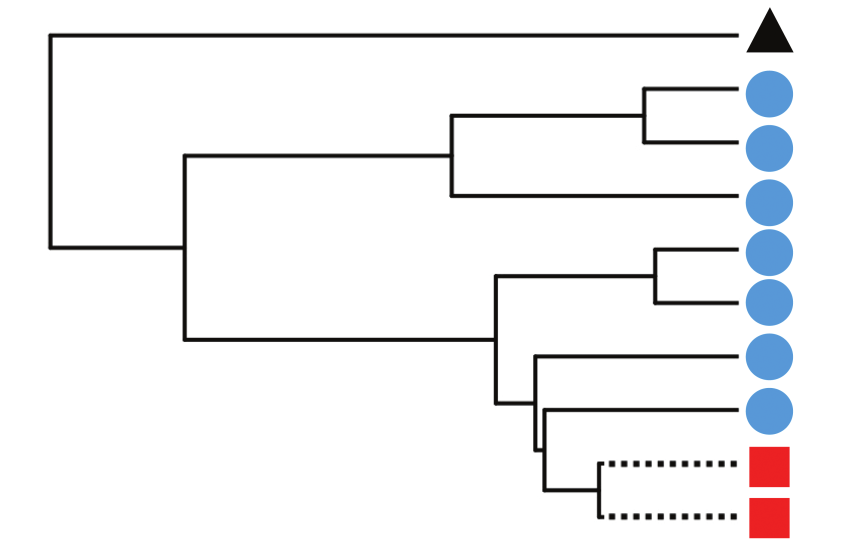
To measure the impact of this misspecification, we simulated morphological data with varying numbers of states per character and then estimated trees under models that assumed either the correct or an incorrect number of states. Mismatched state spaces produced phylogenetic error, particularly in branch lengths. When the state space is assumed to be too large, branch lengths are underestimated; when it is assumed to be too small, they are overestimated.
This project grew out of my Master’s thesis at Southeastern Louisiana University with Dr. April Wright, and was published as a Point of View in Systematic Biology.
Khakurel, B., Grigsby, C., Tran, T. D., Zariwala, J., Höhna, S., & Wright, A. M. (2024). The fundamental role of character coding in Bayesian morphological phylogenetics. Systematic Biology, 73(5), 861–871. DOI: https://doi.org/10.1093/sysbio/syae033