Covarion Model for Morphology
Modelling characters that change their speed of evolution across the tree
The rate at which a morphological character evolves is not constant across the phylogeny, and this rate heterogeneity differs between characters. Standard models of morphological evolution, such as the Mk model, assume that every character evolves under a time-homogeneous process across the whole tree. Models of among-character rate variation relax this by letting characters evolve at different rates, but each character still keeps the same rate on every branch.
The covarion model, originally developed for molecular data, allows sites to switch between rate classes along the tree. In this project, we extended the covarion model in RevBayes to morphological characters, an approach we call the covariomorph model.
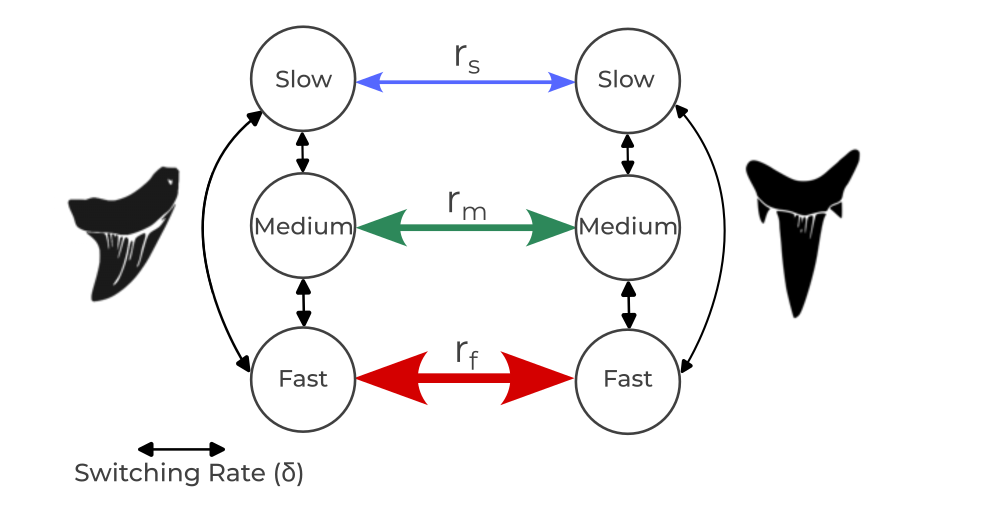
Rate categories are derived from a discretized probability distribution that scales the rate matrix, and characters can switch between categories during evolution. We verified the implementation with simulations and then applied the model to 164 empirical morphological datasets. About half of them showed patterns of rate heterogeneity compatible with covarion-like dynamics. For two focal datasets, the covariomorph model changed both the inferred tree topology and branch lengths compared with traditional models. This sensitivity of branch lengths to model choice has direct consequences for divergence-time estimation and rates of evolution.
This work was published in Systematic Biology. Data and scripts are available on GitHub.
Khakurel, B., & Höhna, S. (2026). A covarion model for phylogenetic estimation using discrete morphological datasets. Systematic Biology. DOI: https://doi.org/10.1093/sysbio/syag014